
A Deeper Look at Value, Trends & Financing for Your Remodel
This is the companion to our pricing guide, “What Does a Remodel Cost?” It’s for homeowners who want to go a level deeper before committing to a project — where we fit in the market, why costs have moved the way they have, how to think about cost over the life of your home rather than just the sticker price, how people actually pay for these projects, and an honest look at whether a remodel is worth it in the first place.
Where ALC Design Falls in the Market
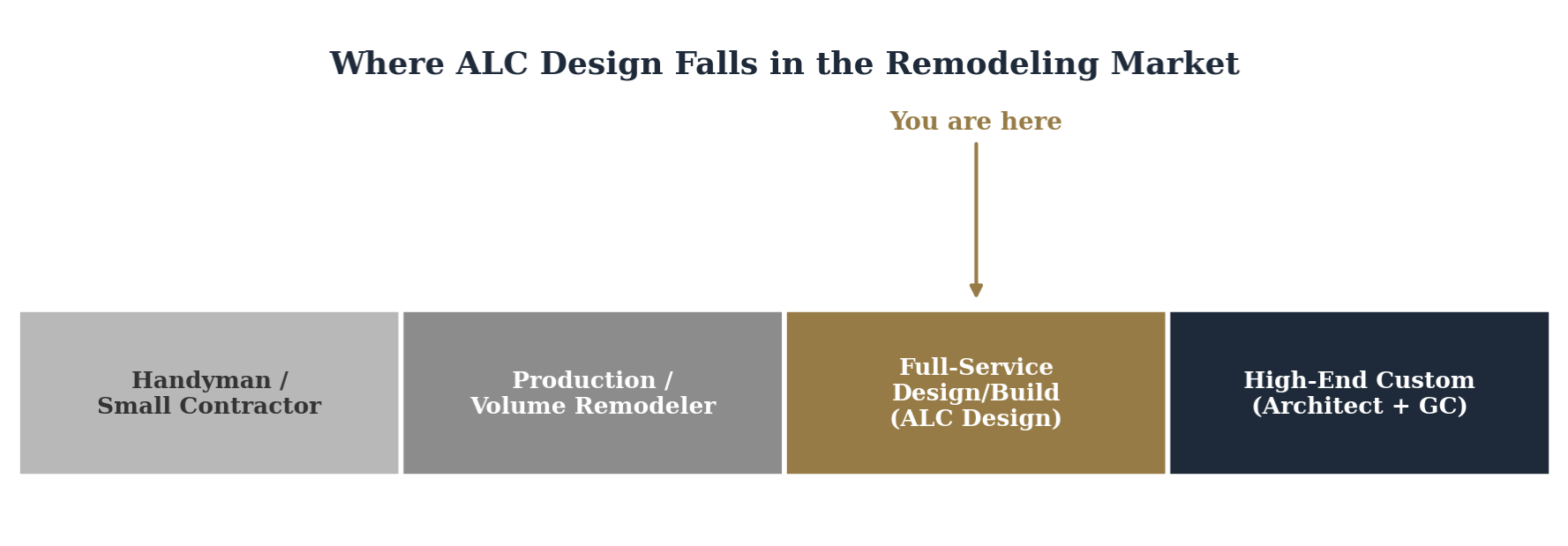
Not all remodeling companies do the same job, even when they use the same words. It helps to see the market as a spectrum:
- Handyman / small contractor — lower cost, best suited to small repairs and cosmetic touch-ups. Limited capacity for larger structural or design-intensive work, and design services (if offered at all) are informal.
- Production / volume remodeler — standardized floor plans and curated selection packages let these companies move faster and buy materials in volume, which lowers cost per square foot. The trade-off is less design flexibility — you’re choosing from their options, not building around yours.
- Full-service design/build (ALC Design) — design and construction under one team, one point of accountability, and a guaranteed price before work begins. You get more customization than a production remodeler and more cost certainty than hiring separately, without the added time and coordination risk of the tier to the right.
- High-end custom, architect + GC — the most design freedom, because you hire an architect and a general contractor separately. It typically costs more and takes longer, because the design and bidding happen in sequence rather than together, and there’s no single team accountable for both the vision and the price.
We sit deliberately in the design/build tier: more design capability and accountability than a production remodeler, without paying for the extra time and risk of coordinating an architect and a separate contractor yourself.
How the Industry Packages Pricing
Two homeowners can get bids for what looks like the identical project and see very different numbers, and very different kinds of numbers, because remodeling companies structure their pricing in different ways:
|
Pricing Model |
How It Works |
Cost Certainty |
|
Cost-plus (time & materials) |
You pay actual labor and material costs plus a fee. Common for smaller contractors and projects with a lot of unknowns. |
Lowest — final number can move as work progresses |
|
Design-bid-build |
An architect designs the project, then separate contractors submit competing bids to build it. |
Cost isn’t known until design is finished and bids come back |
|
Fixed-price / guaranteed price (ALC’s model) |
Price is locked in once your design and every selection are finalized, before construction starts. |
Highest — the number you agree to is the number you pay |
Inside any of these models, there’s a second layer of packaging: product and finish tiers. This is why “a kitchen remodel” can mean $80,000 or $160,000 — the difference is usually semi-custom cabinetry and quartz versus fully custom inset cabinetry and natural stone, not the size of the room. We walk through those selections with you so you know exactly which tier you’re choosing and why, rather than discovering it in a change order.
Lifetime Cost vs. Initial Price
The lowest bid isn’t always the lowest cost — it’s just the lowest number on day one. A useful way to think about any renovation is cost of ownership: what you’ll spend on this space, directly or indirectly, over the years you live with it.
What resale data actually shows
According to the 2025 Cost vs. Value Report, a minor/midrange kitchen remodel recoups an average of 112.6% of its cost at resale nationally — the only interior project in the top five for return — while a major midrange kitchen remodel recoups closer to 50.9%. A midrange bathroom remodel recoups roughly 74%, and universal-design bathroom updates (aging-in-place features) climbed to a 61.2% average return, up 11 points from the prior year.
Those numbers matter if resale is part of your calculus. But recoup rate is only one part of lifetime cost:
- Durability — well-installed systems and durable materials cost more upfront but need less repair, patching, and premature replacement — the classic “buy it once” argument.
- Energy efficiency — new windows, insulation, and mechanical systems reduce ongoing utility bills, which is a return that never shows up in a resale comp but shows up every month you live there.
- Cost of doing it twice — a rushed or underpriced job that has to be redone — or that generates a stream of change orders — often ends up costing more in total than paying the right price once.
The honest takeaway: initial price tells you what you’ll pay this year. Lifetime cost tells you what the project will actually cost you by the time you sell or by the time it needs redoing — and those two numbers aren’t always the same project at two different prices.
Historical Pricing Trends
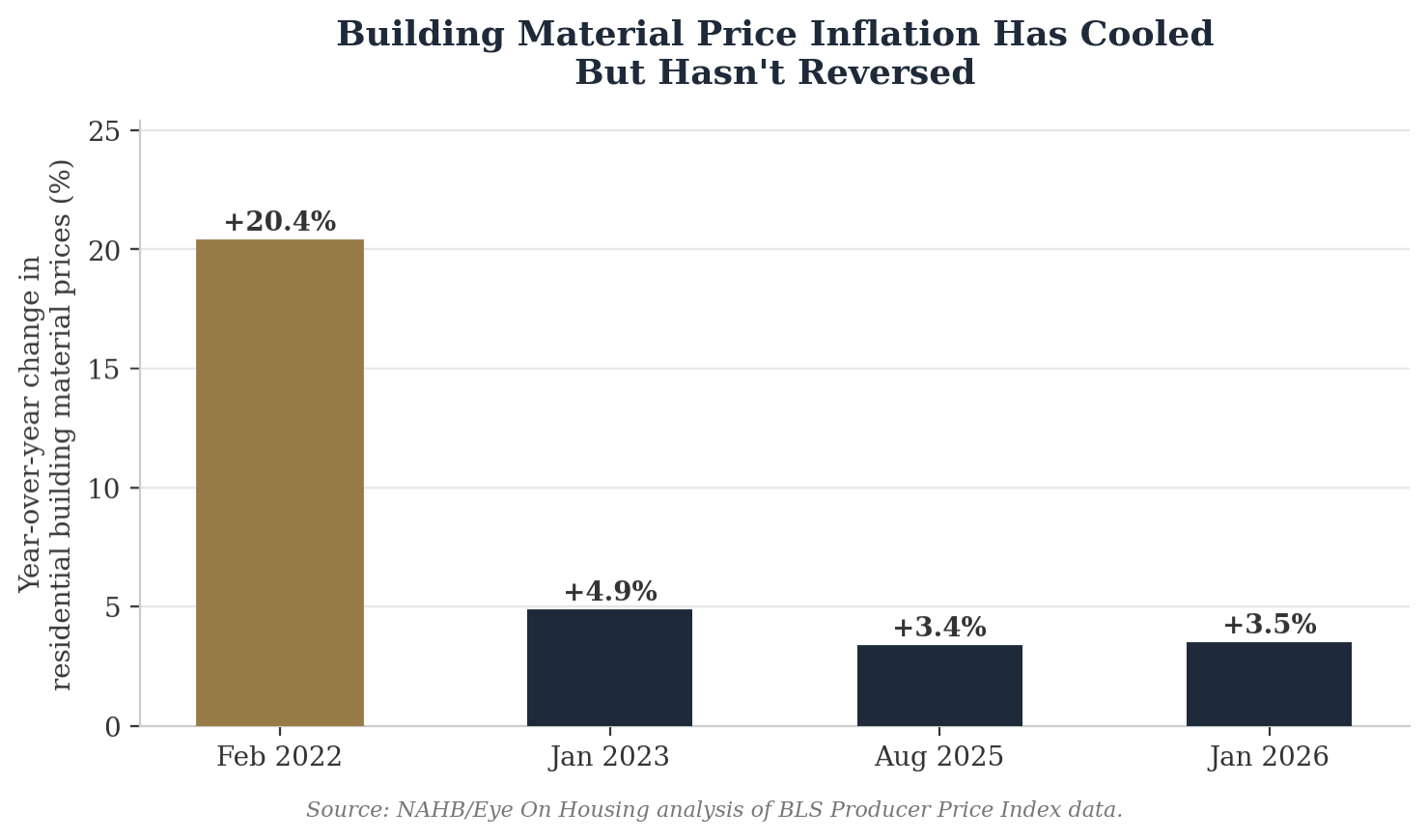
Remodeling costs didn’t rise gradually — they spiked. Lumber prices rose more than 300% during 2020–2021, and residential building material prices overall climbed 31.3% between January 2020 and February 2022, according to NAHB analysis of Bureau of Labor Statistics data. That spike is the biggest reason a project that might have been quoted in 2019 costs meaningfully more today.
Since then, the rate of increase has cooled substantially — building material prices were still rising in the high single digits in early 2023, and by 2025 and into 2026 that pace had settled to roughly 3.5% year-over-year. That’s a much calmer trend line than 2021–2022, but it is still a rising trend line, not a falling one. Prices have not returned to pre-2020 levels, and there’s no strong signal that they will.
What this means practically: waiting for remodeling costs to drop back to what they were a few years ago isn’t a strategy that current data supports. Costs today reflect a new, higher baseline, with modest continued upward drift layered on top of it.
Financing Your Project
Most homeowners pay for a remodel with some combination of savings and financing. Here are the vehicles people use most often — this is general information, not financial or lending advice; a lender or financial advisor can tell you what fits your specific situation.
|
Option |
Best For |
Trade-off |
|
Home equity loan |
A firm scope and quote, and you want a predictable fixed payment. |
Lump sum upfront; closing costs typically $2,000–$5,000. |
|
HELOC |
Multi-phase projects or scope that may change as you go. |
Variable rate — payment can rise if rates move. |
|
Cash-out refinance |
Homeowners who can refinance into a lower or comparable rate and prefer one payment. |
Resets your primary mortgage; closing costs apply. |
|
FHA 203(k) / Fannie Mae HomeStyle |
Buying a home that needs work, rolling purchase and renovation into one loan. |
More paperwork and approval steps than a standard mortgage. |
|
Personal loan |
Smaller projects, good credit, no home equity to draw on, fast funding. |
Higher interest rate; no collateral required. |
|
Contractor / dealer financing |
Convenience of financing through the company doing the work. |
Often 2–5 points higher than financing you arrange directly. |
We’re happy to talk through how other clients have financed similar projects — but for the specifics of what you qualify for and what it will cost you, we’d point you to your bank, credit union, or a mortgage broker.
Is It Really Worth It?
We’re not going to give you a one-line answer, because there isn’t an honest one. Whether a remodel is “worth it” depends on what you’re actually solving for, and it’s worth being clear-eyed about both sides.
The case that it’s worth it
- Financial — if resale is part of the goal, kitchen and bathroom updates are consistently among the higher-return projects nationally, and some (like minor kitchen refreshes) can recoup more than their cost.
- Personal and functional — a home that fits how you actually live — how you cook, how guests move through the space, whether the primary bath works for your morning routine — has a value that doesn’t show up on a spreadsheet but shows up every day.
- Practical — replacing failing systems, adding safety features, or fixing genuine problems (moisture, structural, electrical) has value regardless of resale, because the alternative is living with — or eventually being forced to pay for — the problem.
The case for caution
- Not every project pays for itself — a major kitchen remodel recoups roughly half its cost at resale on average. If resale within the next year or two is your primary goal, a full gut renovation may not be the highest-value move compared to a lighter refresh.
- Over-improving for your market is a real risk — spending significantly more than comparable homes in your neighborhood support can mean you don’t recover that investment at sale, regardless of how well the work is done.
- Financing costs are part of the real cost — financing a renovation adds a monthly cost on top of the project cost; that number needs to make sense against your budget independent of any future resale value.
So: is it worth it? If you’re staying put and the project improves how you actually live in your home, the honest answer is usually yes, even when the resale math isn’t the headline reason. If resale in the near term is the primary driver, the answer depends heavily on which project, your specific market, and how it compares to similar homes nearby — and that’s a conversation worth having with real numbers for your specific house, not a national average.
Let’s Talk Through Your Specific Numbers
National data and industry averages are a useful starting point, but your home, your goals, and your budget are specific to you. A free in-home consultation is where we turn all of this into a real answer for your project.
Call 603-404-2907 or request your free consultation today.
Sources: NAHB/Eye On Housing analysis of U.S. Bureau of Labor Statistics Producer Price Index data; 2025 Cost vs. Value Report (Zonda/JLC). Financing information is general and educational; consult a lender or financial advisor for guidance specific to your situation. Figures reflect national and regional data current as of publication and are subject to change.